
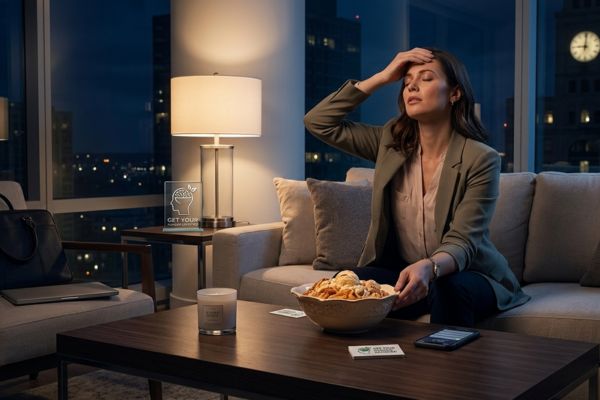
Emotional Eating at Night After a Long Day: Stress, Exhaustion, and Why Food Feels Like Relief
Nighttime emotional eating is one of the most common patterns among high-achieving women struggling with food.
It often looks like this:
You start the day with good intentions.
You manage responsibilities, decisions, and expectations.
You push through stress and exhaustion.
You finally slow down at night.
And then something shifts.
Food suddenly feels louder than everything else.
It is not random. It is not lack of discipline. It is the accumulation of everything your nervous system has been carrying all day without release.
Throughout the day, many women suppress stress, override hunger cues, ignore emotional fatigue, and stay in “function mode.” There is no space to process emotions or decompress mentally.
So when the day ends, the body and mind finally look for release.
Food becomes the quickest, most accessible form of comfort.
Not because it is the real solution.
But because it is familiar.
Nighttime eating is often less about hunger and more about relief-seeking behavior. The body is not asking for fuel—it is asking for regulation.
This is why even after a full meal, the urge to snack or overeat can still feel intense.
The real driver is emotional depletion.
At night, the brain is tired of decision-making. The nervous system is overstimulated. Emotional bandwidth is low. And the internal demand for comfort becomes stronger than logic.
Food steps in as a substitute for rest, emotional processing, or grounding.
And because food works quickly, the cycle reinforces itself.
This is also why willpower feels weakest at night. It is not a lack of strength. It is cognitive fatigue combined with emotional buildup.
Over time, this pattern can create guilt and confusion. Many women begin to wonder why they “can do so well all day” but lose control at night.
But there is no loss of control. There is only unmet internal need finally expressing itself.
Nighttime emotional eating is often the point where everything unprocessed during the day shows up at once.
Stress.
Pressure.
Loneliness.
Overwhelm.
Mental exhaustion.
Food becomes the outlet that absorbs it all.
Understanding this pattern changes everything. It shifts the focus away from restriction and toward awareness of emotional load.
Because when the real issue is depletion, control-based solutions never last.
At Get Your Hunger Satisfied, we help women uncover what their nighttime eating is actually responding to so food no longer becomes the only source of relief.
If nighttime eating feels like your hardest pattern, it may be time to understand what your hunger is really asking for. Book a free strategy call with Get Your Hunger Satisfied.





